AVE H0 Models
The AVE (Alta Velocidad Española) is the Spanish high-speed train of RENFE, in service since 1992. In H0 scale the AVE family is produced almost exclusively by Electrotren — from the AVE S-100 (TGV Atlantique-based) through the AVE S-101 Euromed to the Talgo-based AVE S-102 and AVE S-112 in their Renfe Operadora liveries.

What is the AVE?
AVE (Alta Velocidad Española) is the RENFE brand for Spanish high-speed services. The first AVE line Madrid–Seville opened in 1992 for the World's Fair — unlike the classic Spanish network it runs on standard gauge (1435 mm) rather than Iberian broad gauge (1668 mm). Today the AVE network connects Madrid with Barcelona, Seville, Málaga and Valencia, and crosses the Pyrenees into France.
AVE generations
- AVE S-100 — the first AVE generation, technically identical to the French TGV Atlantique, built by Alstom from 1991. Still in service on the Madrid–Seville line.
- AVE S-101 Euromed — variant based on the TGV Réseau, originally for the Mediterranean line Barcelona–Valencia–Alicante.
- AVE S-102 „Pato" — Talgo 350, with its characteristic flat duck-bill front, built by Talgo/Bombardier from 2005.
- AVE S-112 „Pato" — evolution of the S-102 with extended bodyshell, by Talgo/Bombardier from 2010.
- AVE S-130 (Talgo 250) — the variable-gauge Talgo trainset that can switch between Iberian broad gauge and standard gauge (prototype reference; no current H0 production model).
H0 models and manufacturers
- Electrotren — the Spanish manufacturer covers almost the entire AVE family: S-100, S-101 Euromed, S-102, S-112, in analogue and digital, in the various Renfe liveries.
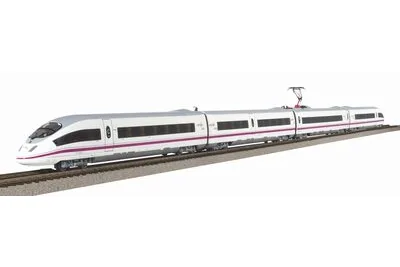
- Piko — starter set with AVE livery on roadbed track.
Related topics
The AVE is part of Spain's railway identity — see the overview of all H0 models from Spain, the Renfe collection and the related Talgo carriage design principle (basis for AVE S-102/S-112). In the international high-speed context the AVE is the direct relative of the French TGV (S-100 = TGV Atlantique). AVE models cover Eras V and VI.